
Your First Spartan Race: What to Expect and How to Prepare
Sign up for the Sprint.
It is Spartan’s shortest race, a 5K (3.1 mi) with about 20 obstacles, built to be a realistic first outing.
Expect a muddy, hilly course, a handful of tough obstacles, and a fair chance you will owe some burpees along the way.
None of that is a reason to worry.
Start with the Sprint

The Sprint is Spartan’s easiest branded race, built specifically for first-timers.
At 5K with roughly 20 obstacles, it is long enough to feel real and short enough to finish without months of training.
The Sprint sits at the entry point of Spartan’s full race lineup.
From here it continues through the Super, Beast, and Ultra, each stage longer and more obstacle-heavy than the last.
Here is how they compare.
| Race | Distance | Obstacles |
|---|---|---|
| Sprint | 5K (3.1 mi) | About 20 |
| Super | 10K (6.2 mi) | About 25 |
| Beast | 21K (13+ mi) | About 30 |
| Ultra | 50K (31 mi) | About 60 |
Once the Sprint feels manageable, most first-timers look at moving up to the Super for their second race.
The jump in difficulty from Sprint to Super is real, not just a longer version of the same course.
There is no rush to skip ahead until the Sprint feels comfortable.
Spartan grew out of Joe De Sena’s brutal Death Race, with the first branded Spartan Race held in Vermont in 2010.
It has been a timed, competitive event from the start.
Nothing stops you from treating your first Sprint as a personal challenge instead of a race against the clock.
Spartan itself describes its races as “hard, but designed to be achievable for anyone willing to commit.”
The Sprint is where that promise is easiest to test.
What race day actually looks like
Races run in heats, so you line up with your group at an assigned start time instead of setting off alone.
You start in a wave with dozens of other racers and spend one to two hours moving through mud, hills, and obstacles.
Expect a mix of trail and hills, plus a genuinely muddy course underfoot for most of it.
The terrain does as much work as the obstacles do.
Finish times vary enormously between racers, so there is no need to race the clock on your first lap.
Treat the obstacles as the real test, not your split time.
Along the way you will meet obstacles built to test strength, grip, and nerve more than raw speed. Common ones include:
- Wall climbs of varying heights
- A rope climb, roughly 12 to 16 feet
- Monkey bars and similar hanging rigs
- The spear throw
- Loaded carries, including the sandbag, the bucket carry, and the Atlas carry
- A barbed wire crawl, low to the ground and usually through more mud
It helps to know the basics of staying safe in a mud run before you line up, since footing and fatigue cause most trouble.
The 30 burpee penalty is not something to fear
Every obstacle carries a price for failing it, and that price is burpees, not disqualification.
Miss the spear throw, fall off a rig, or cannot finish a wall climb, and the penalty is 30 burpees before you move on.
This is normal, not embarrassing.
Most first-timers fail at least one obstacle, and plenty of experienced racers do too.
Other racers will often help you over a wall or up onto a rig, and you will do the same for them.
That kind of teamwork is part of the event, not a rule you need to ask permission for.
How to train for your first Spartan race
Train in three layers: a running base, functional strength and grip, then loaded carries that copy the course.
Start by building toward running the full distance comfortably.
For the Sprint, that means jogging or running 5K over mixed terrain, not just flat pavement.
Layer in functional strength next.
Squats, lunges, and pressing movements build the whole-body strength the obstacles demand.
Add grip work too, since a weak grip is what actually ends most first attempts at a rig or rope.
Dead hangs, farmer carries, and practice carries with a loaded bag all transfer directly to race day.
You do not need a gym to get ready.
A weighted backpack covers carries, a playground bar or sturdy branch covers grip, and bodyweight squats and lunges cover strength.
Consistency matters more than equipment.
Spartan’s own program, called Project 300, is a structured 28 week plan that builds all of this from scratch.
If you already run regularly, you do not need the full program.
Add two or three sessions a week of strength, grip, and loaded carries on top of your existing mileage, and you will show up prepared.
What to wear and bring
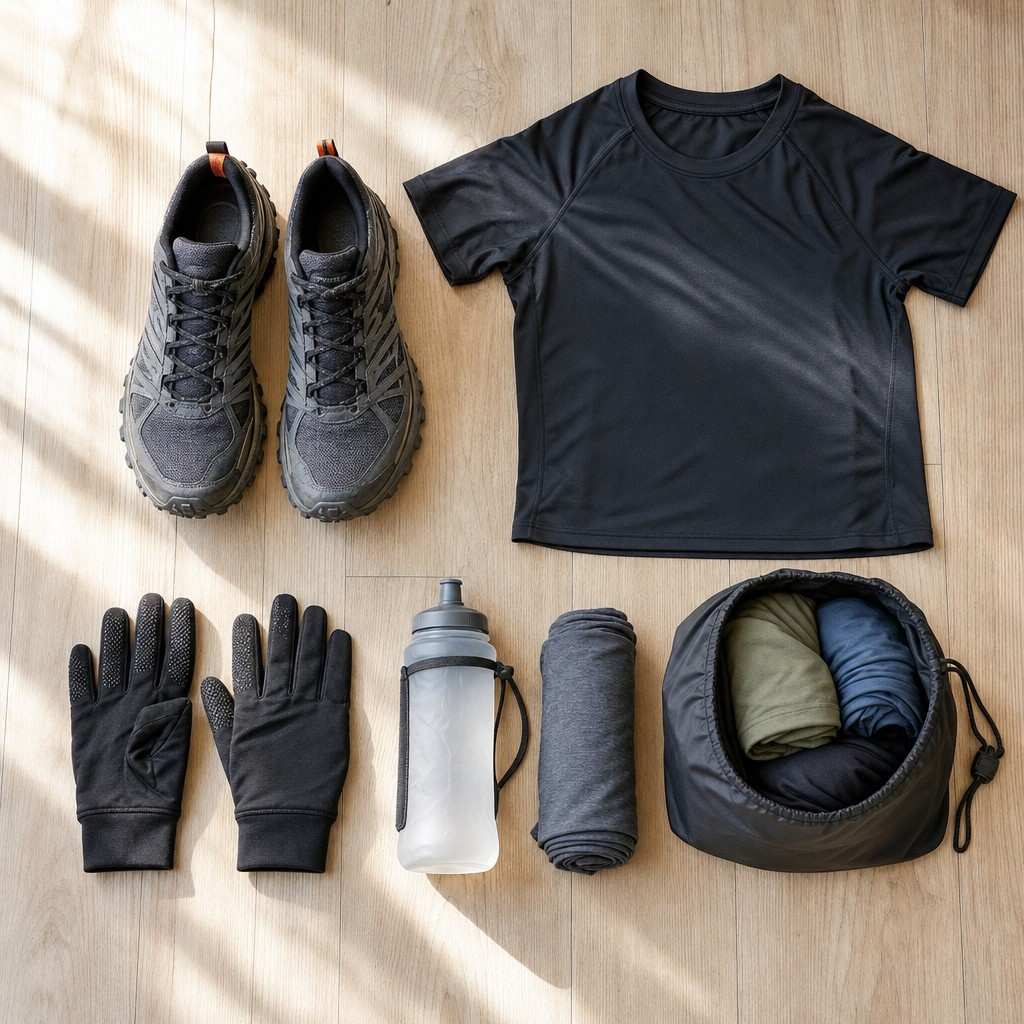
Trail running shoes with real lugs matter more than any other gear choice, since most of the course is wet ground, mud, and loose rock.
Choose fitted clothes over loose ones.
Wear trail shoes with real grip, fitted clothes that shed water, and skip the cotton entirely.
Loose fabric soaks up mud and water, gets heavy fast, and can snag on obstacles, while snug synthetic layers shed both and dry faster.
Cotton socks and shirts hold water and cause chafing over an hour or more of movement, so pick synthetic or wool instead.
Pack a dry change of clothes for after the race, since you will finish soaked and muddy.
Bring hydration, whether that is a handheld bottle or a small pack, since even the Sprint can take over an hour of steady effort.
Grip gloves are optional, but worth considering if you are nervous about the rope climb or the rig.
First-timer mistakes to avoid
Most first-race problems come from undertrained grip and the wrong clothes, not a lack of fitness.
- Skipping grip and carry training, then getting stopped by a rig or rope instead of the running.
- Wearing cotton or loose clothing that soaks up mud and rubs you raw by the finish.
- Starting too fast in the wave and having nothing left for the obstacles.
- Avoiding an obstacle instead of attempting it, when the burpees are often faster than standing around.
- Skipping hydration because the distance looks short on paper.
- Leaving grip and carry training until race week, when it takes weeks to build.
- Forgetting a dry change of clothes for after the finish.
The bottom line
Expect a hilly, muddy course, a real mix of obstacles, and burpees if something does not go your way.
Train your grip and strength alongside your running, dress to get wet, and treat the whole day as a personal challenge.
A well-prepared first-timer finishes the Sprint proud, muddy, and already thinking about the Super.
That is really all a first Spartan race asks of you.