How to Foam Roll After Running
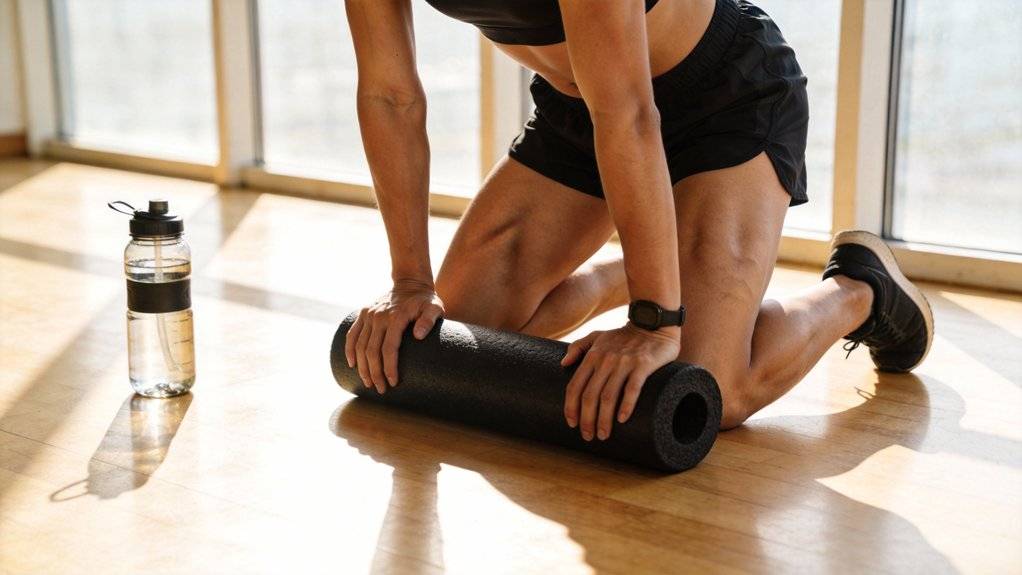
Roll each major muscle group slowly for 30 to 60 seconds, ideally soon after your run. Move at a slow, deliberate pace, pause a little longer on any tender spot, and never roll directly on a joint or on your lower spine. That’s the whole method.
The rest is just applying it to the right muscles in the right order.
This article contains affiliate links. If you buy through them, we may earn a small commission at no extra cost to you.
Why foam roll after a run
Your legs take on real fatigue during a hard run, and the muscle fibers around your calves, quads, and hamstrings tend to tighten up as you cool down. Rolling those areas may help reduce soreness and can leave your legs feeling looser for the next session.
It won’t undo a hard effort, and it isn’t a substitute for proper recovery. Think of it as one small piece alongside planned rest days and normal stretching, not a shortcut around them.
How to foam roll each muscle group
Work through each area slowly rather than rushing the whole routine. A steady pass with a short pause on tight spots does more than a fast, bouncy one.
Calves
Sit with the roller under one calf and your hands on the floor behind you for support. Roll from just above the ankle up to below the knee, then cross one leg over the other to add pressure on the tighter side.
Spend 30 to 60 seconds per leg, slowing down wherever the muscle feels dense or sore.
Quads
Lie face down and rest the roller under your thighs, propped up on your forearms. Roll from just above the knee up toward your hip, keeping the motion slow enough that you can feel where the muscle is tightest.
Give each leg 30 to 60 seconds, and hold briefly wherever you find a tender spot instead of rolling straight through it.
Hamstrings
Sit on the floor with the roller under one thigh and your hands behind you for support. Roll from just above the knee to just below the glute, letting your body weight set the pressure.
Work each leg for 30 to 60 seconds. If you already deal with sore legs after running, this is usually the spot that needs the most patience.
Glutes
Sit on the roller with one ankle crossed over the opposite knee, leaning slightly toward the side you’re rolling. Move in short passes across the glute muscle rather than long strokes, since this area responds better to a smaller range of motion.
30 to 60 seconds per side is usually enough. A massage ball can reach this area more precisely than a full-size roller if you find the angle awkward.
IT band area
Lie on your side with the roller under the outside of your thigh, between your hip and knee, and roll slowly along that line. Keep the pressure moderate rather than pressing as hard as you can.
The evidence on rolling the IT band itself is mixed. It’s a thick, fibrous band rather than a muscle, so it may not respond to rolling the way your quads or calves do.
Many runners still find it worthwhile, likely because rolling the muscles around the band, not the band itself, is what eases the tightness. Treat this one as optional rather than essential.

- High-density foam roller in Black
- Ideal for balance, strengthening, and flexibility exercises


- IMPROVE MUSCLE RECOVERY – Multi-density GRID features a three-dimensional surface that...
- OPTIMIZED FOR COMFORT – Unique foam construction with proprietary Distrodensity Zones is...

- High-density foam roller in Black
- Ideal for balance, strengthening, and flexibility exercises
How long and how often
- Timing: foam roll as soon as reasonably possible after your run, while the muscles are still warm.
- Duration: 30 to 60 seconds per muscle group is enough for most people.
- Frequency: after harder or longer runs, or 2 to 3 times a week if you roll on a regular schedule.
- Pressure: firm but tolerable. Pain that makes you tense up defeats the purpose.
If you’re still tight the next day, a slow second pass or a few extra minutes with a muscle roller stick on the calves and quads is a reasonable follow-up. It’s easier to control in tight spaces than a full roller.
Mistakes to avoid
- Rolling too fast. Quick, bouncy passes do less than slow, controlled ones.
- Rolling directly on a joint. Keep the roller on muscle tissue, not on your knee, ankle, or hip bone.
- Rolling your lower spine. Stick to your legs, glutes, and upper back if you extend the routine. Never roll the lower back directly.
- Camping on one spot too long. A tender spot deserves a pause, not several minutes of constant pressure.
- Pushing through sharp pain. Mild discomfort is normal. Sharp or shooting pain means stop and ease off.
- Treating it as a fix for everything. If you’re regularly trying to run with sore legs, foam rolling alone won’t solve that. Pair it with proper rest and a sensible training load.
Foam rolling is a small, low-effort habit that fits neatly into your cooldown. Keep the pace slow, the pressure reasonable, and the whole routine under 10 minutes, and it earns its place in your recovery without becoming a chore.