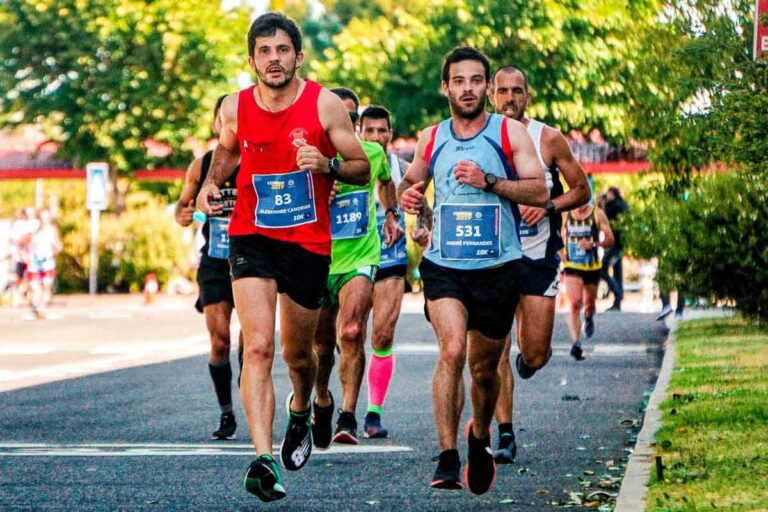
How Long Does It Take To Run A Mile? (Average Times by Age and Sex)

Most adults run a mile in about 9 to 11 minutes, with a typical recreational effort landing close to 10 minutes. Men average roughly 9:03 per mile and women roughly 10:21, while trained recreational runners can bring that down to 7 to 9 minutes and beginners running a mile for the first time often take 12 to 15 minutes.
Enter your pace in the calculator above and it will show your projected finish times for the 5K, 10K, half marathon, and marathon, so one number gives you the full picture.
Running Time Calculator
Enter your pace per mile to see how long it takes you to run a mile and every common race distance.
| 1 mile | – |
| 2 miles | – |
| 5K | – |
| 3 miles | – |
| 10K | – |
| 10 miles | – |
| Half marathon | – |
| Marathon | – |
Times assume you hold an even pace for the whole distance. Real race times drift a little as fatigue sets in over longer distances.
How long it takes to run common distances
Your pace per mile drives every race prediction. The table below shows how long common distances take across a range of paces, from a comfortable beginner jog to a trained recreational effort.
| Pace / mile | 1 mile | 5K | 10K | Half | Marathon |
|---|---|---|---|---|---|
| 7:00 | 7:00 | 21:45 | 43:30 | 1:31:46 | 3:03:32 |
| 8:00 | 8:00 | 24:51 | 49:43 | 1:44:53 | 3:29:45 |
| 9:00 | 9:00 | 27:58 | 55:55 | 1:57:59 | 3:55:58 |
| 10:00 | 10:00 | 31:04 | 1:02:08 | 2:11:06 | 4:22:11 |
| 11:00 | 11:00 | 34:11 | 1:08:21 | 2:24:12 | 4:48:24 |
| 12:00 | 12:00 | 37:17 | 1:14:34 | 2:37:19 | 5:14:38 |
| 13:00 | 13:00 | 40:23 | 1:20:47 | 2:50:25 | 5:40:51 |
Typical mile time by runner type
Mile times vary widely depending on where you are in your running journey. The table below shows typical finish times by runner type, from walkers through competitive amateurs.
| Runner | Pace / mile | Mile time |
|---|---|---|
| Walking | 15:00 to 20:00 | 15 to 20 min |
| Beginner (run-walk) | 12:00 to 15:00 | 12 to 15 min |
| Average recreational | 9:00 to 11:00 | 9 to 11 min |
| Trained recreational | 7:00 to 9:00 | 7 to 9 min |
| Competitive amateur | 5:00 to 6:30 | 5:00 to 6:30 |
What affects your mile time
Several factors push your mile time faster or slower, and knowing them helps you set a realistic target.
- Fitness and training history. Weekly mileage held consistently over months is the single biggest lever on your mile time.
- Effort and pacing. Going out too fast burns through your energy early, so a steady, honest effort almost always produces a better finish.
- Terrain and conditions. Hills, wind, heat, and humidity all add time, while flat roads in cool weather favor your best effort.
- Age. Mile times peak in the teens to early 30s and tend to slow by roughly 30 to 60 seconds per decade after age 40, a pattern seen consistently in large race-result and percentile analyses.
Average mile time by age and sex
Mile times are generally fastest for runners in their teens to early 30s, then decline gradually with age. According to large race-result and percentile analyses, including data compiled by Medical News Today, times tend to slow by roughly 30 to 60 seconds per decade after age 40. Sex is a factor at every age, with men averaging around 9:03 and women around 10:21 across the recreational population.
How to run a faster mile
Getting faster at the mile means training both your aerobic engine and your raw leg speed at the same time.
- Build your aerobic base with easy miles. The majority of your weekly running should be at a comfortable, conversational pace, which develops the endurance the mile demands.
- Add 400 meter interval repeats. Short, fast repetitions at the track teach your legs to turn over quickly and raise the ceiling on your top-end pace.
- Run strides after easy days. A few 20 second accelerations at the end of an easy run sharpen your form and reinforce a faster cadence without heavy fatigue.
- Practice even pacing. Splitting your mile into even halves, rather than sprinting the first half and fading, produces better times and teaches you what your sustainable pace actually feels like.

The bottom line
A typical mile takes around 10 minutes for a recreational runner, with trained runners comfortably in the 7 to 9 minute range and beginners closer to 12 to 15 minutes. The elite end sits at roughly 3:43 for men and 4:07 for women, showing how wide the spectrum is. Plug any pace into the calculator above and it converts your mile time into predicted finish times for every major race distance.
Frequently asked questions
How long does it take to run a mile?
Most adults run a mile in about 9 to 11 minutes, with the typical recreational effort landing close to 10 minutes. Men average roughly 9:03 and women roughly 10:21, though trained runners can go considerably faster.
How long does it take to walk a mile?
Walking a mile typically takes about 15 to 20 minutes at a normal walking pace. Brisker walkers can get under 15 minutes, while a leisurely stroll may take closer to 20.
What is a good mile time?
For a recreational runner, anything in the 7 to 9 minute range is a strong result. Competitive amateurs often run 5:00 to 6:30, and the world records sit at roughly 3:43 for men and 4:07 for women.
How long does it take a beginner to run a mile?
Beginners and run-walkers typically complete a mile in about 12 to 15 minutes. With a few weeks of consistent practice, most people can work that down toward the 10 to 11 minute range.
How do I run a faster mile?
Combine easy aerobic miles to build your base with short, fast intervals such as 400 meter repeats to develop leg speed. Adding a few strides after easy runs and practicing even pacing on your mile efforts will also help your time drop.
Similar Posts
How to Pace Yourself When Running (4 Simple Tips for a Successful Run)
You set out on a run, hoping to improve your fitness. Within a few minutes, you’re breathing heavily. Soon, you’ll experience a burning sensation in your chest and throat, your legs will feel weak, and your shoulders will be tight. …
Is A 10-Minute Mile Good (Or Slow) For A Beginner Runner?
Running a mile in 10 minutes is DEFINITELY a good time for a beginner when you compare it to the average times!
Typically, your average mile time might be closer to 12-15 minutes if you are a beginner runner.
How Much Running Is Too Much? How to Find Your Sweet Spot
Runners love numbers. One such number they tend to get stuck on is the mileage they plan to achieve in a single run. But how much running is too much? While there’s no true limit to how much running you…
How Long Should You Be Able to Run Without Stopping? 5K Or More?
Running without stopping and taking breaks comes with preparation and training. If you are a beginner, you are not going to be able to run 10K and take no breaks because fitness doesn’t work that way. It is all about…
How Often Should You Run? (Tips for Optimal Health Benefits)
Running is perfect for you if you are looking for a new form of cardio to challenge yourself and your body. However, running too often can be more harmful than helpful. Well, how often should you run then? If you…